Getting your ATO (Approved Training Organisation) certificate is the part everyone prepares for. The 12-month audit cycle that follows it is the part that quietly determines whether you keep that certificate.
Most of the admin work in a Kenyan flying school is reactive. A student needs a document, an aircraft needs a sign-off, an instructor needs a currency check.
The independent audit is the one recurring obligation that is entirely on you to schedule, run, and act on, and it does not wait for KCAA to ask.
The Short Version
- Every aspect of an ATO's compliance must be independently audited at least once every 12 months, either as one exercise or spread across a scheduled plan.
- The person conducting the audit cannot be responsible for the area they are checking. Independence is a defined requirement, not a courtesy.
- Findings and corrective actions must feed back to senior management and ultimately to the accountable manager, with a defined process for what happens if a fix does not land on time.
- Renewal of ATO certification depends on demonstrated continuous compliance under KCAA's current advisory circular, CAA-AC-PEL070D. It is not automatic.
- An adequate, KCAA-approved fleet and an adequate number of properly rated instructors are baseline requirements the audit checks, not one-time boxes ticked at certification.
The audit that never really stops
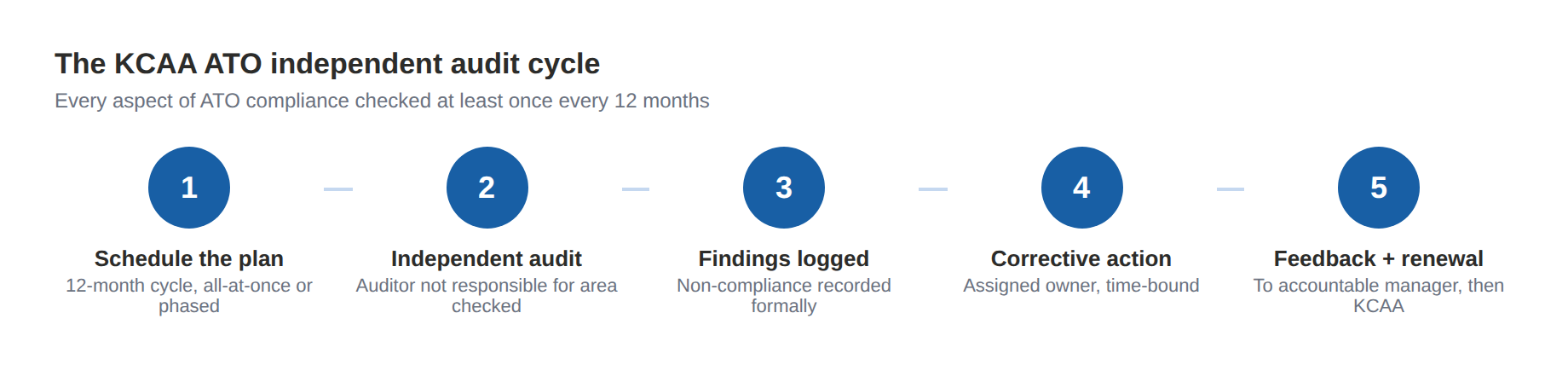
KCAA's advisory circular on ATO certification, AC-ATO 001C, sets out the independent audit procedure that every ATO must run. All aspects of the organisation's compliance need to be checked at least once every 12 months, and the school can either do that as a single exercise or subdivide it across a scheduled plan through the year (KCAA AC-ATO 001C).
Read that requirement carefully and it stops sounding like paperwork. A 12-month cycle means the audit is a standing obligation on the calendar, not an event that only happens around renewal time.
Schools that treat it that way, as a genuine cycle rather than a pre-renewal scramble, are the ones that walk into a KCAA inspection with clean records instead of a weekend of catch-up.
What "independent" actually means in KCAA's own words
The circular is specific about who can run the audit. The person or team conducting it must not be responsible for the function or procedure being checked, full stop.
That rules out an instructor auditing their own training records, or the person who maintains the fleet signing off on the fleet's own compliance. For a small school this can be a genuine logistical problem, and the honest answer is that it needs solving deliberately rather than quietly ignored.
A cross-check arrangement between the Head of Training and the Head of Operations, or bringing in an external reviewer for the areas where no internal separation exists, is the kind of structure that satisfies the requirement without needing a large administrative headcount.
Findings, corrective action, and who actually owns the fix
An audit that finds nothing is either a genuinely well-run school or an audit that was not looking hard enough. Either way, the requirement does not stop at finding issues.
KCAA's quality-management expectation is that audit findings and corrective actions get fed back to the ATO's senior management, and ultimately to the accountable manager, so the person legally responsible for the school's compliance actually sees the result. The system must also define who is required to rectify each discrepancy, and what happens if the fix is not completed within the agreed time (KCAA AC-ATO 001C).
That last part matters more than schools tend to expect. A finding that gets logged and never closed out is arguably worse on inspection than not having caught it in the first place, because it shows the internal process itself is not working.
The fleet and instructor side of the audit
Certification regulations require an ATO to maintain an adequate fleet of training aircraft, approved by KCAA, and appropriate to the courses it actually teaches. The same regulation requires an adequate number of ground and flight instructors, each holding the correct rating or authorisation for the instruction they give, plus initial and continuation training for that instructional staff (Civil Aviation (Approved Training Organizations) Regulations, 2018).
None of that is a one-time check at certification. Fleet composition changes, instructors leave or their currency lapses, and course offerings shift.
An audit that only re-reads the original certification application instead of the school's current reality is not really auditing anything.
What happens when a finding does not get closed
KCAA's own escalation logic is explicit that a corrective action left open is not a neutral outcome, the system has to define what happens next if it is not completed within an appropriate time scale. In practice that means an unresolved finding does not just sit quietly on a spreadsheet, it is meant to trigger a defined escalation within the school before it ever reaches KCAA's attention.
Schools that skip building that escalation path end up improvising it under pressure, usually right before a renewal inspection, which is the worst possible time to design a process for the first time.
A school with a genuinely functioning audit system can point to specific findings, specific fixes, and specific dates. A school without one can only offer assurances, and assurances are not what an inspector, or an incident investigator, is looking for.
Foreign ATOs are held to the same discipline
It is worth knowing this exists even if it does not apply to most Kenyan schools directly, because it shows how consistently KCAA applies the same audit logic. Certification of a Foreign Approved Training Organisation, covered under KCAA's CAA-AC-PEL082A, follows the same underlying principle of demonstrated, ongoing compliance rather than a one-time approval.
The message for a domestic ATO is the same either way. There is no lighter-touch version of this cycle for a school that has been operating for years versus one newly certified, the 12-month independent audit obligation applies regardless of how long the school has held its certificate.
Renewal is not a formality
KCAA's current advisory circular on this, CAA-AC-PEL070D, updated in February 2026, governs both certification of a prospective training organisation and renewal of an already-approved one. The renewal path assumes continuous compliance with the applicable regulations and procedures, unless the ATO's approval has been suspended or revoked (KCAA CAA-AC-PEL070D).
The word "demonstrated" is doing real work there. A school cannot simply assert it has been compliant, it needs the audit trail, the corrective-action records, and the fleet and instructor documentation to show it.
The opinion part
Here is the part worth saying plainly. Treating the annual audit as a compliance chore to survive rather than a management tool to use is the single biggest mistake I see schools make with this process.
The audit exists to surface exactly the gaps that would otherwise only show up during an incident investigation, when it is far too late to fix them quietly. A school that runs its internal audit properly is not doing extra work for KCAA's benefit, it is finding its own problems before an inspector, an incident, or a lawyer does.
What an accountable manager should have ready
None of this needs to be complicated, but it does need to be current and it does need to exist in writing.
- A written 12-month audit schedule, dated, showing what gets checked when, not a vague intention to "do it sometime this year."
- Proof of auditor independence for each area checked. Who audited the fleet records, and were they responsible for maintaining those records themselves.
- A findings log with status, not just a list of what was found, but what was assigned to whom, by when, and whether it actually closed.
- Evidence the accountable manager saw the findings, because feedback to senior management is a named requirement, not an assumption.
- Current fleet and instructor records matched against what the school is actually operating and teaching today, not what was true at last certification.
A record system with a genuinely append-only history, one that cannot be quietly edited after the fact, makes the "evidence" half of that list far less painful to produce on demand. That is a useful property to look for in whatever system a school runs its dispatch and training records through, independent of which platform provides it.
Why paper records make this harder than it needs to be
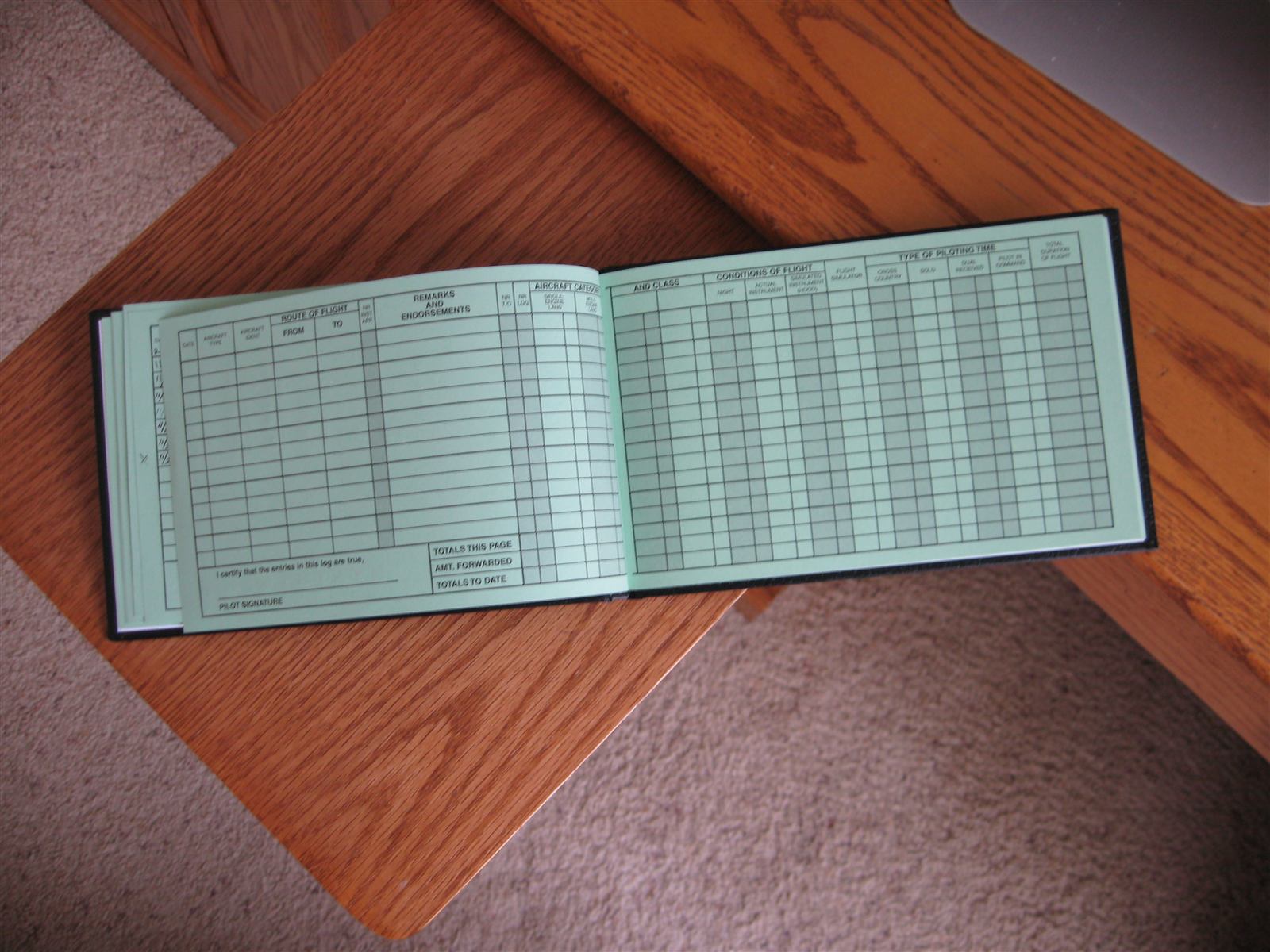
A lot of the friction schools describe around audit season is not really about the regulation, it is about the record-keeping method underneath it. A findings log kept in a notebook, or across several people's private files, cannot show an inspector a clean, dated, tamper-evident history on demand.
KCAA's own testing and examination, record-keeping, and quality-control expectations for ATOs assume the school can actually produce that history when asked, not reconstruct it from memory. That is a records-management problem before it is a compliance problem, and it is worth treating it as one.
Frequently asked questions
How often does KCAA require an ATO's independent audit?
At least once every 12 months, either as a single complete exercise or subdivided across a scheduled plan through the year.
Can an instructor audit their own training records?
No. The person conducting the audit must not be responsible for the function or procedure being checked, which rules out self-auditing of any kind.
What happens to findings once the audit is complete?
They must be fed back to senior management and ultimately the accountable manager, with a defined process for corrective action and for escalation if a fix is not completed on time.
Is renewal of ATO certification automatic if nothing has obviously gone wrong?
No. Renewal under CAA-AC-PEL070D depends on demonstrated continuous compliance with applicable regulations, which means documented evidence, not an absence of complaints.
Key Takeaways
- KCAA requires every ATO to run an independent audit covering all aspects of compliance at least once every 12 months.
- The auditor must be independent of the area being checked, which forces smaller schools to design a genuine cross-check, not a self-review.
- Findings and corrective actions must reach the accountable manager, with ownership and a deadline attached to every fix.
- Fleet and instructor adequacy are checked on an ongoing basis, not settled once at certification and forgotten.
- Renewal under CAA-AC-PEL070D depends on demonstrated continuous compliance, which means documentation, not just a clean incident record.