
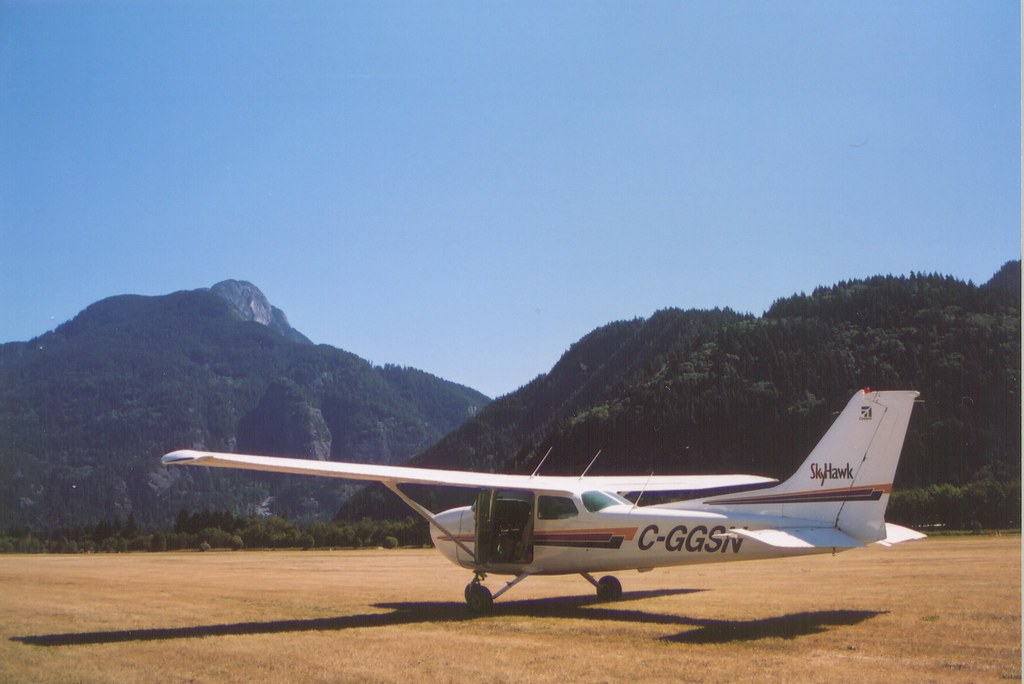
Every safari-flying student hears the same line about game on the strip: overfly first, land second. Fewer are told that this is not a courtesy or a bit of bush wisdom, it is you personally executing a legal safety function that a certified aerodrome would normally staff with trained people and a vehicle.
At Wilson or JKIA, a wildlife hazard is someone else's job. At Ol Kiombo, Kichwa Tembo, or a Samburu strip after rain, it is yours, and most students are never told that plainly.
This is not the bird strike article
AngaBrief has already covered the raptor and vulture risk that Wilson's boundary with Nairobi National Park creates, and that remains a real and distinct hazard. This article is about a different category entirely: large terrestrial animals, giraffe, buffalo, zebra, warthog, elephant, standing on or crossing the actual landing surface of Kenya's bush and game-park airstrips.
Birds are mostly an airborne hazard you fly through. A grazing buffalo is a stationary obstruction on the one strip of ground you need clear to land or take off, and it does not care that you have right of way.
What the rulebook actually requires
Wildlife hazard management is not an informal bush-flying custom, it is a defined regulatory obligation. ICAO's risk-based approach to wildlife hazard management under Annex 14 requires states to assess wildlife strike hazard and take action to reduce the risk of collision, with the Airport Services Manual, Doc 9137 Part 3, setting out how an aerodrome is meant to build a formal Wildlife Hazard Management Programme covering risk assessment, habitat management, and active deterrence.
Kenya's own Aerodromes Regulations, 2013 bring that obligation into domestic law, and KCAA's own aerodrome certification guidance lists a bird and wildlife hazard management manual as a required part of any aerodrome manual submitted for certification.
Read that requirement against the map of where Kenyan students actually fly passengers, and the gap becomes obvious fast. A certified aerodrome like Wilson has to run that programme formally, while an unlicensed strip beside a conservancy, which is where most of Kenya's bush flying actually happens, usually has no one running it at all.
The partnership Kenya just signed to close that gap
This is not a theoretical gap KCAA is ignoring. KCAA and the Kenya Wildlife Service (KWS) have formally reinforced their collaboration on aerodrome safety, bringing KCAA Director General Emile Arao and KWS Director General Erustus Kanga together to align KWS-managed airstrips with aviation safety standards.
The scale of what that partnership is trying to fix is worth sitting with. KWS operates roughly 30 government aerodromes across the country, strips that exist for park surveillance, wildlife rescue, and tourism access precisely because they sit inside or beside the reserves that draw the animals in the first place.
That is a good and overdue step, and it also confirms something every Mara-bound student should already assume: regular compliance auditing of wildlife hazard management at these strips is a work in progress, not a solved problem. Until it is fully rolled out, the pilot on short final is the wildlife hazard management programme.
Why a grazing animal is not "just a bird, but bigger"
It is tempting to file large-animal strikes under the same mental folder as bird strikes, only scaled up. The physics and the regulation both say that is the wrong model.
The FAA's Advisory Circular 150/5200-32C, Reporting Wildlife Aircraft Strikes, sets a specific reporting threshold: any terrestrial mammal larger than about one kilogram is a reportable wildlife strike, a category built around exactly the kind of grazing and browsing animals that gather near open grassland and water sources. In the FAA's own national strike database, deer alone account for roughly 83 percent of all reported aircraft-mammal collisions in the United States, and the agency's data shows most of those strikes happen at night, when the animal's behaviour is hardest for a pilot to predict.
Kenya's version of that risk profile runs the opposite way on timing and the same way on unpredictability. Zebra, wildebeest, giraffe, and buffalo around Kenyan bush strips are mostly day-active, grazing exactly during the hours you are most likely to be flying, and an animal that looks settled from altitude can bolt in any direction the moment engine noise or a low pass startles it.
What it actually costs when it goes wrong
The Aviation Safety Network's record of a Cessna 172, registration V5-ETS, is a plain illustration of what a large-animal strike does to a light aircraft, not a jet. On 8 October 2004 the aircraft struck a giraffe during a takeoff accident at Santawani airstrip near Botswana's Okavango Delta, a bush strip environment very similar to Kenya's own game-park airfields.
The aircraft sustained substantial damage, the giraffe did not survive, and the pilot walked away with only minor injuries. That last detail is the one worth remembering: light aircraft on a takeoff or landing roll are not moving fast enough for a large-animal strike to reliably be survivable purely by luck, and the outcome in that case depended on exactly where on the airframe the impact landed.
A C172 or PA-28 was never built with any certified resistance to a strike like that. Part 23 light aircraft carry no equivalent to the bird-impact windscreen standards that apply to transport-category jets, and nothing in a typical trainer's structure is designed around absorbing an impact with an animal that can weigh several hundred kilograms.
The AOPA Air Safety Institute's own accident analysis of animal strikes makes the same point from a different angle: the impact itself is often survivable, but what a pilot does with the aircraft immediately afterward is what decides the outcome. Its review of a go-around strike that collapsed a landing gear leg is a reminder that the strike is rarely the end of the sequence, it is the start of a decision you have not necessarily briefed for.
The FAA's own national wildlife strike report records the more sobering version of that same lesson. In its case history of a Piper Cherokee that struck a deer on rotation, the pilot's attempt to turn back for the runway ended short of it, in trees, the only serious injury the FAA's terrestrial mammal strike data has on record.
There is no wildlife officer at Ol Kiombo
At a certified airport, wildlife hazard management usually means trained staff, a patrol vehicle, and sometimes active deterrence equipment, all working before your aircraft ever gets near the threshold. At an unlicensed Kenyan bush strip, that entire function collapses down to one person: you, in the aircraft, on the overfly.
The FAA's own guidance on routine airfield inspection, Advisory Circular 150/5200-18D, Airport Safety Self-Inspection, treats checking the movement area for wildlife presence as a standing, formal item in an aerodrome operator's inspection routine, done before it becomes the pilot's problem. At Ol Kiombo, Kichwa Tembo, or a Samburu strip with nobody stationed there, that inspection step does not disappear, it just moves entirely onto your circuit.
That reframes the overfly from a nice habit into the actual safety function the regulation assumes someone is performing. You are not checking the strip out of caution, you are standing in for an inspection an unlicensed aerodrome has no one else to run.
The decision threshold, not just "look for animals"
"Watch for game" is the advice every bush-flying student hears, and it is not specific enough to act on consistently. The honest version needs a threshold, not a vibe.
A settled herd grazing well clear of the strip, heads down, moving away from the noise of your low pass, is a condition you can usually work with, provided you keep watching it through the approach. An animal that raises its head toward the aircraft, or a herd that scatters unpredictably rather than moving cleanly off the surface, is a stop condition, full stop, whatever your fuel state or schedule pressure is telling you.
This is the opinion worth stating plainly: too much bush-flying culture treats the go/no-go call on game as a feel-based judgement passed down as folklore, rather than a threshold that gets taught explicitly and drilled the same way a crosswind limit does. A crosswind limit does not get softer because you are running late, and neither should this one.
The data nobody at an unlicensed strip is collecting
A bird control programme at a certified airport works because strike reports feed it, and the same logic applies to terrestrial wildlife. ICAO's wildlife strike reporting framework, and the FAA's own AC 150/5200-32C alongside it, exists because a hazard management programme is only as good as the data showing which strips, which seasons, and which species actually produce close calls.
An unlicensed Kenyan bush strip with no staff has no one filing that report after a near-miss with a herd on short final. If the KCAA-KWS partnership is going to turn roughly 30 KWS-managed aerodromes into places with a real wildlife hazard picture, that picture has to be built from somewhere, and pilots flying those strips are currently the only people positioned to see the pattern forming.
Reporting a close call or a strike to your operator, and through them to KCAA, is not paperwork for its own sake. It is the only mechanism that turns "that strip gets busy with zebra in the wet season" from hangar folklore into something an aerodrome authority can actually act on.
Instructors: brief this before the first Mara trip, not after a scare
A good CFI (Certified Flight Instructor) who has flown safari routes has almost certainly had a herd closer to the centreline than planned at some point. Few instructors turn that into a standing, named briefing item before a student's first unsupervised trip into Mara or Amboseli airspace.
Naming the threshold explicitly costs one sentence: settled and moving away is workable, head-up or scattering is a go-around, no exceptions for schedule. A student who hears that once, as a rule rather than a story, is far more likely to actually apply it under real pressure than one who only absorbed it as hangar talk.
What pilots admit on the forums
Bush-flying forum threads about wildlife on the strip follow a recognisable pattern. The original post is usually a mildly funny story, a zebra that would not clear, a giraffe that ambled across on short final.
The replies are where the real information sits, and it is rarely as light-hearted. Experienced pilots routinely admit that the close calls that actually worried them were not the obvious herds you see from three miles out, they were the single animal spotted late, already close to the centreline, that forced a decision with very little time to make it well.
The Short Version
- Wildlife hazard management is a formal regulatory requirement under ICAO Annex 14 and Kenya's own Aerodromes Regulations, 2013, not a bush-flying custom.
- Most Kenyan game-park strips have no staffed wildlife control programme, so the pilot performs that function alone, on every overfly.
- KCAA and KWS have formally strengthened their partnership to align roughly 30 KWS-managed aerodromes with safety standards, confirming this is a live, unfinished gap.
- Large terrestrial animals are a distinct hazard from birds, unbuilt for by Part 23 aircraft structure, and capable of serious damage even in a low-speed takeoff or landing accident.
- Treat the go/no-go call on game as a hard threshold, settled and clearing versus head-up or scattering, not a feel-based judgement that bends under schedule pressure.
AngaBrief's PAVE assessment asks a pilot to record environmental hazards specific to the departure and arrival aerodrome, which for an unlicensed bush strip includes exactly this kind of wildlife risk. The tool records that consideration in the audit log; it is not a dispatch authority, and the go or no-go decision always stays with the pilot in command and their instructor.
Key Takeaways
- Wildlife hazard management at an unlicensed Kenyan bush strip is a legal aerodrome safety function with no one staffed to run it but the pilot.
- Terrestrial mammal strikes are tracked as a distinct, reportable hazard category by regulators precisely because they are common and damaging, not a novelty.
- A giraffe strike destroyed a Cessna 172 on takeoff at a bush strip closely comparable to Kenya's own game-park airfields.
- Set a hard go/no-go threshold for game on the strip before the flight, not during it, and brief it explicitly rather than leaving it as folklore.