
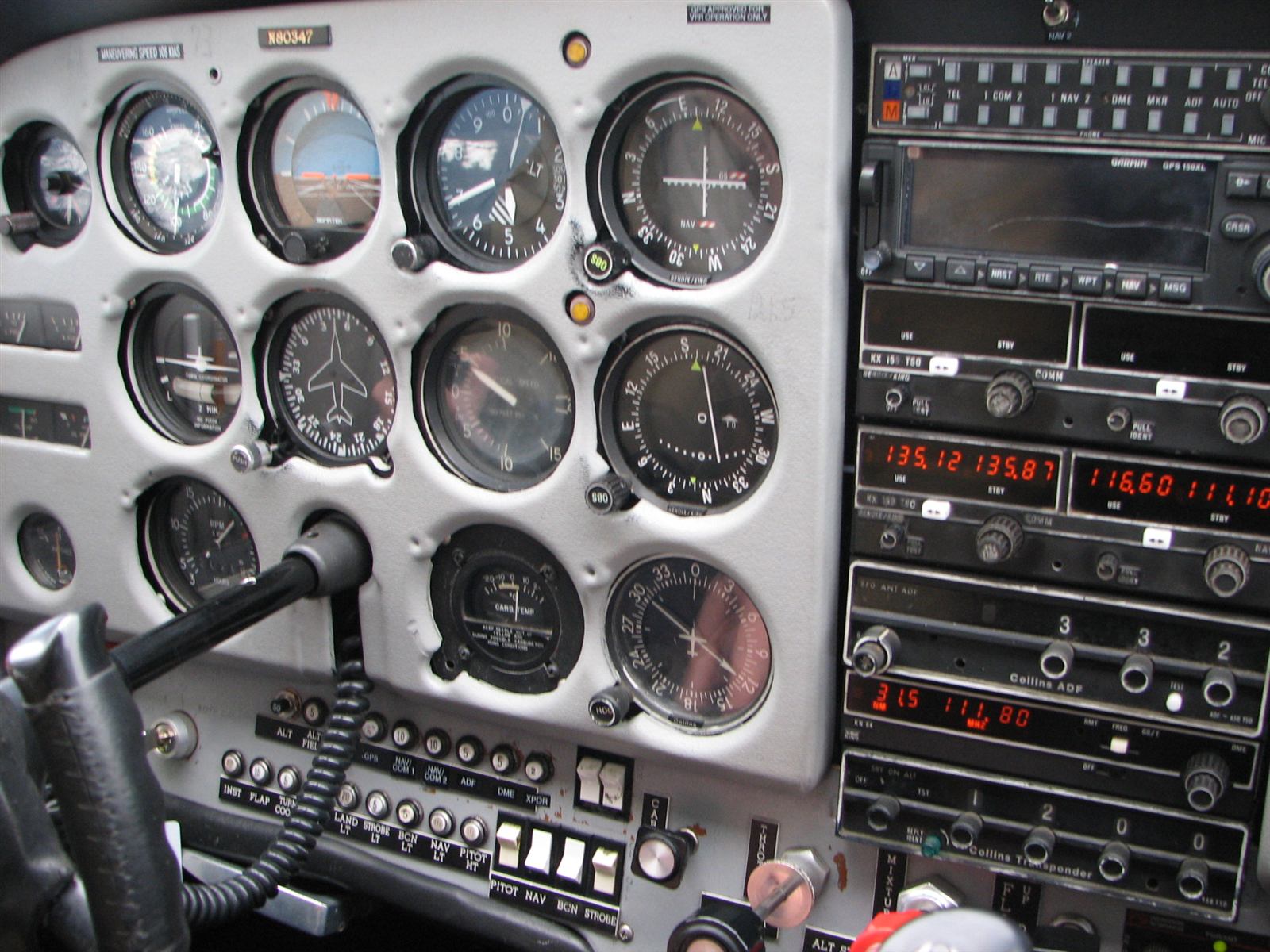
Look at the two gyro instruments in a standard C152, C172 or PA-28 panel: the attitude indicator and the heading indicator. Both are usually spun by a vacuum pump bolted to the engine's accessory case, and that pump can fail completely without the gauge giving you any warning first.
Most Kenyan student pilots train VFR only and never touch a hood or foggles, so nobody drills this failure into them. That is a gap worth closing, because the aircraft does not check your syllabus before its pump quits.
What the vacuum system actually drives
In the three aircraft types that make up most Kenyan basic training, the attitude indicator and the heading indicator (directional gyro) are typically vacuum-driven, spun by suction from an engine-mounted pump. The turn coordinator, by contrast, is usually electric, which matters a great deal the moment the vacuum side dies.
The FAA's AC 91-46, Gyroscopic Instruments: Good Operating Practices, exists because this split-power arrangement is common across light aircraft, and pilots are expected to know which instruments survive a given failure and which do not.
Why the failure gives you no warning
A vacuum pump does not announce its own decline. Accident investigations into vacuum-related losses of control repeatedly describe the same pattern: the gauge reads normally until the moment the pump stops, at which point the attitude indicator and heading indicator simply start drifting or toppling with no preceding drop to flag the problem.
The FAA's AC 91-75, Attitude Indicator, deals with exactly this risk at the regulatory level, setting out which backup configurations, an independent electric attitude indicator, or a second vacuum or pressure source, are acceptable so that a single pump failure does not leave a pilot with no attitude reference at all.
What the research says pilots actually do when it happens
The clearest evidence comes from a joint FAA Civil Aerospace Medical Institute (CAMI) and AOPA Air Safety Foundation study from 2002, reported by AOPA. Researchers triggered an unannounced failure of the attitude and heading instruments in real aircraft, 25 pilots flying a Piper Archer, the same PA-28 family Kenyan schools fly, and 16 flying a Beechcraft Bonanza A36.
The pilots who had done 30 minutes of partial-panel practice beforehand recognised the failure faster than those who had not. That is the entire finding in one sentence, and it is also the entire case for doing the drill at all.
An earlier CAMI simulator study, cited in AOPA's own vacuum-failure training guidance, found a loss-of-control rate of 83 percent in a high-performance Piper Malibu against 8 percent in a Cessna 172 facing the identical failure. The basic trainer is the forgiving end of this problem, not the dangerous end, but forgiving is not the same as automatic.
The accident pattern behind the number
AOPA's Air Safety Foundation, in the same training guidance, found 40 accidents between 1983 and 1997 in which a vacuum pump was implicated, with a failed pump listed as the direct cause in 13 of them and a contributing factor in most of the rest. Thirty-two of those 40 accidents were fatal.
Separately, AOPA has put the overall odds at around one accident in a thousand being traceable to a pump failure, while noting that about 90 percent of general aviation flying happens in visual conditions, where a dead gyro is an inconvenience rather than a crisis, because you can look outside.
That last point is the whole reason this gets ignored in VFR-only training. The failure is genuinely low-probability, and in clear air with a visible horizon it is close to harmless.
The risk concentrates entirely in the moment VFR flying stops being purely visual, which in Kenya happens more often than the syllabus admits.
Why Kenyan VFR training skips this skill entirely
Kenyan PPL and CPL training is structured around staying VFR and avoiding instrument conditions, not flying through them, which is the right priority and is covered well by weather decision-making and PAVE training elsewhere. But avoidance training and recovery training are not the same skill, and only the first one gets taught.
Add the local fleet reality. Many Kenyan trainers are older airframes with simple steam-gauge panels, a vacuum-driven attitude indicator and heading indicator, and an electric turn coordinator as the only instrument guaranteed to survive a pump failure.
There is no glass backup to fall back on if the single vacuum pump quits.
Students who have never been shown a partial-panel scan have no mental model for what a vacuum failure actually looks like. The first time they would meet it is the worst possible time to meet anything new: already in degraded visual conditions, already behind the aircraft, with an instrument lying to them and no reason yet to disbelieve it.
Kenya's weather does not make that scenario rare enough to ignore. The long rains and the shorter October-to-December rains both lower cloud bases across the training areas around Nairobi and the highlands.
A dawn departure into haze or a patch of stratus hugging a ridge line is a far more ordinary event than a planned instrument approach, and the visual conditions a VFR pilot is counting on can thin out well before anyone calls it marginal.
That is the scenario this skill is actually for. Nobody is suggesting a student pilot push into cloud on purpose, only that a brief, unplanned loss of outside reference and a failing gyro are both real possibilities on the same bad day, and training for one without the other leaves a gap exactly where it is least convenient.
The cross-check that catches it before it becomes an emergency
AC 91-46's core teaching point is a disciplined instrument cross-check, not a single glance at one gauge. Applied to a vacuum failure, the practical version is this: your attitude indicator and heading indicator are only trustworthy if they agree with everything else on the panel.
- Check the turn coordinator. It is electric, so it survives a vacuum failure and will disagree with a failing attitude indicator almost immediately.
- Check the compass against the heading indicator. A magnetic compass has its own quirks in turns and climbs, but in steady flight it will not drift the way a failing gyro does.
- Check the altimeter and vertical speed trend. A pitch attitude the altimeter and VSI do not support is a strong clue the attitude indicator is the one lying.
- Look outside whenever you can. In VFR conditions the horizon outranks every instrument on the panel, which is precisely why this failure matters so little until the horizon disappears.
None of this requires an instrument rating. It requires knowing, before the moment arrives, which instruments are allowed to vote and which one has just been voted off the panel.
What the failure actually looks like on the panel
A failing attitude indicator rarely goes blank. It usually keeps displaying a bank or pitch attitude, just a wrong and slowly worsening one, which is exactly why it is dangerous rather than merely annoying.
The heading indicator behaves the same way, drifting a few degrees at a time rather than freezing or flagging an error. A pilot who is not actively cross-checking has no reason to doubt either gauge until the discrepancy with the turn coordinator or the compass has grown large enough to be obvious, by which point a wrong control input or two may already be in the aircraft's flight path.
Why this is a fleet and maintenance issue as much as a flying one
A vacuum pump failure does not arrive at random. It is a mechanical component with a service life, and like any mechanical component on a shared training aircraft it is only as well managed as the maintenance programme tracking it.
This is where the Aircraft factor in PAVE connects back to the tech log rather than the cockpit. A school that logs every rough-running instrument, every sluggish gyro spin-up, and every pilot report of an erratic attitude indicator gives its maintenance programme a fighting chance of catching a weakening pump before it fails outright, rather than discovering the problem in flight.
A student who notices something odd about a gyro instrument on the ground and says nothing because the flight still "feels fine" has quietly removed that early-warning option from the whole fleet, not just their own lesson.
A ten-minute drill worth asking your instructor for
The 2002 FAA and AOPA study used 30 minutes of partial-panel practice as its training intervention, and it was enough to produce a measurable improvement in recognition speed. You do not need anywhere near that to get the basic idea into your hands.
Ask your CFI (Certified Flight Instructor) to cover the attitude indicator and heading indicator with a sticky note during a dual lesson, in good VMC, well clear of terrain and traffic, and have you fly straight and level, then a standard-rate turn, using only the turn coordinator, compass, airspeed and altimeter. It costs ten minutes of a lesson you are already paying for, and it is the only way to find out what a partial-panel scan actually feels like before it happens for real.
What pilots admit about vacuum failure
Vacuum-failure threads on pilot forums have a familiar shape. Almost nobody admits to losing control outright, and almost everybody who has actually had a pump die mid-flight admits to a few seconds of genuine confusion before they worked out which instrument had stopped telling the truth.
The recurring theme is not panic, it is delay, pilots trusting a failing attitude indicator for longer than they should because distrusting an instrument you have relied on for hundreds of hours does not come naturally. That delay is exactly what a rehearsed cross-check is designed to remove.
The Short Version
- The attitude indicator and heading indicator in most basic trainers are vacuum-driven and can fail completely with no warning drop on the gauge.
- A 2002 FAA and AOPA study using real Piper Archer and Beechcraft Bonanza flights found 30 minutes of partial-panel practice measurably sped up how fast pilots recognised the failure.
- AOPA Air Safety Foundation data links vacuum pumps to 40 accidents from 1983 to 1997, 32 of them fatal, with the risk concentrated almost entirely outside visual conditions.
- Kenyan VFR-only training teaches avoidance of instrument conditions well, but rarely teaches recovery skills for when a vacuum instrument fails anyway.
- The fix is a disciplined cross-check against the electric turn coordinator, compass, altimeter and the horizon outside, rehearsed once in VMC before it is ever needed for real.
AngaBrief's pre-flight assessment asks students to record the aircraft's known equipment and defects under the Aircraft factor of PAVE, which is where a vacuum system issue belongs if one has ever been logged. The tool records that assessment; it is not a dispatch authority, and the go/no-go decision always rests with the pilot in command and their instructor.
Key Takeaways
- A vacuum pump failure gives no warning on the gauge, so the attitude indicator and heading indicator can be wrong well before you notice.
- The turn coordinator is usually electric and survives a vacuum failure, making it your first honest cross-check.
- Thirty minutes of partial-panel practice has been shown to speed up how fast pilots catch the failure. Ask for ten.
- The risk is almost entirely a non-visual-conditions problem, which is exactly why VFR-only training tends to skip it.